Pentomino Tiling with Dancing Links 中文
Introduction
Donald Knuth introduced the Dancing Links (DLX) algorithm in The Art of Computer Programming Volume 4B — an elegant backtracking algorithm for solving exact cover problems. This post explores the classic application mentioned in Exercise 7.2.2.1-31: pentomino tiling.
What Are Pentominoes?
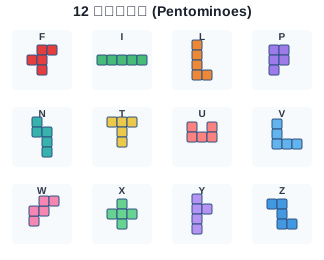
Pentominoes are polyominoes made of 5 unit squares connected edge to edge. Ignoring rotations and reflections, there are 12 distinct pentominoes, typically named after letters they resemble: F, I, L, P, N, T, U, V, W, X, Y, Z:
Problem Definition
Classic problem: Can you tile a 6×10 rectangle using all 12 pentominoes, each exactly once?
This generalizes to other rectangle sizes:
- 5×12
- 4×15
- 3×20
From Tiling to Exact Cover
Dancing Links solves exact cover problems:
Given a 0-1 matrix, select a set of rows such that every column contains exactly one 1.
Constructing the Matrix
For pentomino tiling, we build the following matrix:
Columns:
- Each grid cell (6×10 = 60 columns)
- Each pentomino type (12 columns)
- Total: 72 columns
Rows:
- For each pentomino type
- Consider all valid placements (position + orientation) within the rectangle
- Each row = one “placement option”
- The 1s mark occupied cells and the piece type used
Example
Suppose we place the L pentomino at position (0,0):
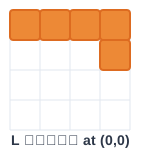
Row: [L-type, (0,0), (1,0), (2,0), (3,0), (3,1)] — six 1s.
The Dancing Links Algorithm
DLX uses a doubly-linked circular list (a “toroidal” structure) to represent the sparse matrix, enabling efficient backtracking:
Data Structure
ColumnHeader ↔ ColumnHeader ↔ ColumnHeader ↔ ...
       ↓              ↓               ↓
    DataNode ↔ DataNode ↔ DataNode
       ↓
    DataNode
Algorithm Flow
Algorithm X(cover):
    if matrix empty:
        solution found!
    choose column c (fewest options)
    cover column c
    for each row r in column c:
        add r to solution
        for each column j in row r:
            cover column j
        X(cover)
        remove r from solution
        for each column j in row r:
            uncover column j
    uncover column c
Optimization: Minimum Remaining Values
The key optimization of DLX — always choose the column with the fewest options — maximizes pruning.
Core Implementation
The heart of DLX lies in the cover and uncover operations, which use doubly-linked lists for efficient backtracking:
def cover(self, col):
    """Cover column col: remove column and all intersecting rows from matrix"""
    # 1. Remove column from column list
    self.R[self.L[col]] = self.R[col]
    self.L[self.R[col]] = self.L[col]

    # 2. Remove all rows that intersect this column
    i = self.D[col]
    while i != col:
        j = self.R[i]
        while j != i:
            self.D[self.U[j]] = self.D[j]  # Skip node j
            self.U[self.D[j]] = self.U[j]
            self.S[self.C[j]] -= 1  # Decrement column count
            j = self.R[j]
        i = self.D[i]

def uncover(self, col):
    """Uncover column col: exact reverse of cover operation"""
    # 1. Restore all removed rows (in reverse order)
    i = self.U[col]
    while i != col:
        j = self.L[i]
        while j != i:
            self.S[self.C[j]] += 1  # Restore column count
            self.D[self.U[j]] = j
            self.U[self.D[j]] = j
            j = self.L[j]
        i = self.U[i]

    # 2. Restore column to column list
    self.R[self.L[col]] = col
    self.L[self.R[col]] = col
Key Points:
coveroperation must be reversible for exact backtracking- Use
LandRpointers to skip nodes horizontally - Use
UandDpointers to skip nodes vertically Sarray tracks node count per column for MRV heuristic
Full implementation available at: GitHub - pentomino_dlx.py
Sample Output
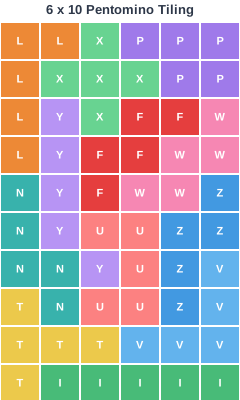
A solution tiling a 6×10 rectangle with all 12 pentominoes
Complexity Analysis
Space Complexity
- For 6×10 rectangle, each column has \(O(n)\) nodes at most
- Total nodes ≈ number of placement options
- Space: \(O(\text{placements})\)
Time Complexity
- Worst case: exponential \(O(2^n)\)
- In practice, DLX’s pruning is very effective
- Pentomino problems typically solve in milliseconds
Extensions and Variations
1. Other Polyominoes
- Trominoes: 2 types (straight, L-shaped)
- Tetrominoes: 5 types
- Hexominoes: 35 types — interestingly, all 35 free hexominoes cannot tile any rectangle. A checkerboard parity argument proves this: 24 “odd” hexominoes cover 3 black + 3 white, while 11 “even” ones cover 4 black + 2 white (or vice versa), so total black squares covered is always even; yet any 10×21 rectangle has 105 black squares (odd) — a contradiction. However, they can tile regions with holes (e.g., a 15×15 square with a central 3×5 removed). Full code at hexomino_dlx.py.
2. Counting Problems
According to the literature, the 6×10 pentomino tiling has 9,356 distinct solutions (counting rotations and reflections). This is a classic result in combinatorial mathematics that has been verified by multiple different methods.
3. Variants
- Rectangles with holes
- Non-rectangular regions
- Using a subset of pieces
- Allowing repeated pieces
Conclusion
The pentomino tiling problem perfectly showcases the power of Dancing Links:
- Elegant Modeling: Transform geometric problems into exact cover
- Efficient Algorithm: Doubly-linked lists enable fast backtracking
- Highly Extensible: Generalizes to other constraint satisfaction problems
This embodies Knuth’s design philosophy: Find the essential representation of the problem, then implement it with the most appropriate data structure.
References
- Knuth, D. E. (2022). The Art of Computer Programming, Volume 4B: Combinatorial Algorithms, Part 2. Addison-Wesley.
- Dancing Links - Wikipedia
- Exact Cover - Wikipedia

